
Business
Outcomes and operating model
What the organisation is trying to become, which capabilities that requires, and who will own each of them afterwards.
- Capability model
- Value-stream mapping
- Operating-model design
- Investment prioritisation
↑↓ move · ⏎ open · esc close
Consulting · Digital Transformation Strategy
Enterprise transformation fails on commitment structure more often than on technology. We sequence the work into phases that each deliver something in production and each end at a decision gate — so you are never asked to fund five years on a single early guess.
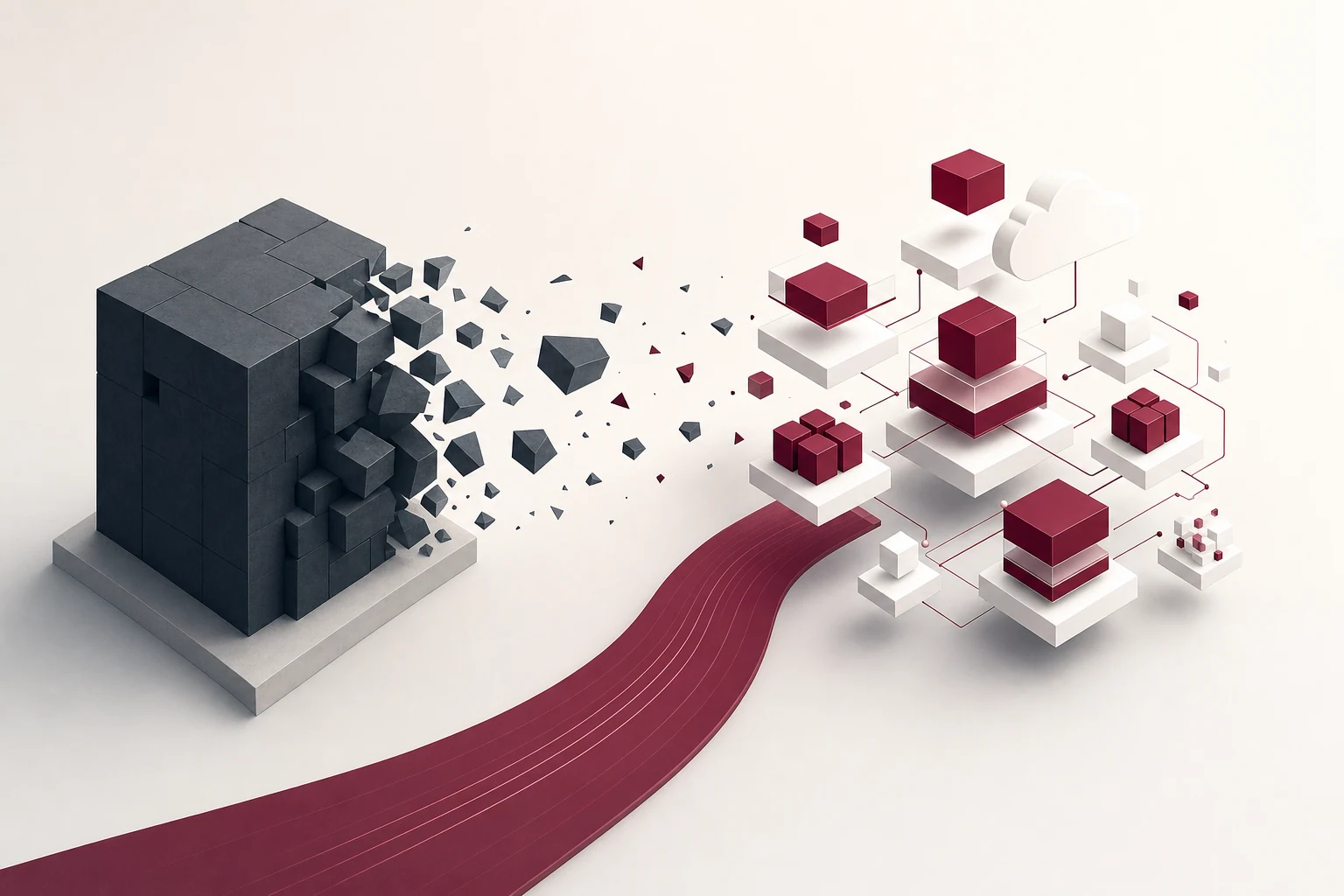
Where programmes stall
None of these are technology problems. All of them are decided before procurement starts, which is why the strategy work comes first.
Transformation planned as procurement — five platforms in a sequence — with no statement of which business outcome each one moves.
Each department owns its application; the end-to-end process that crosses four of them has no owner and therefore never improves.
The estate is discussed as "the old system" when in reality a minority of it blocks the business and the rest is cheap to leave alone.
Workloads lifted as-is, so the operating cost rises, the architecture does not improve, and the promised agility never arrives.
Reporting and AI ambitions collide with data nobody owns, usually after the platform contract is signed.
The organisation has absorbed several partial rollouts and now assumes the next one will also be abandoned halfway.
The framework
Treating any one of these in isolation is the most reliable way to produce a plan that cannot be executed. Technology chosen without process ownership is the classic example.
Business
What the organisation is trying to become, which capabilities that requires, and who will own each of them afterwards.
Process
The real path a request takes, including the spreadsheets and phone calls, measured before anyone proposes a system to replace it.
Technology
Which applications are retained, re-platformed, rebuilt or retired, and what has to exist underneath to make that possible.
Data & AI
Ownership, definitions, quality and access — the unglamorous prerequisite that every analytics and AI ambition eventually depends on.
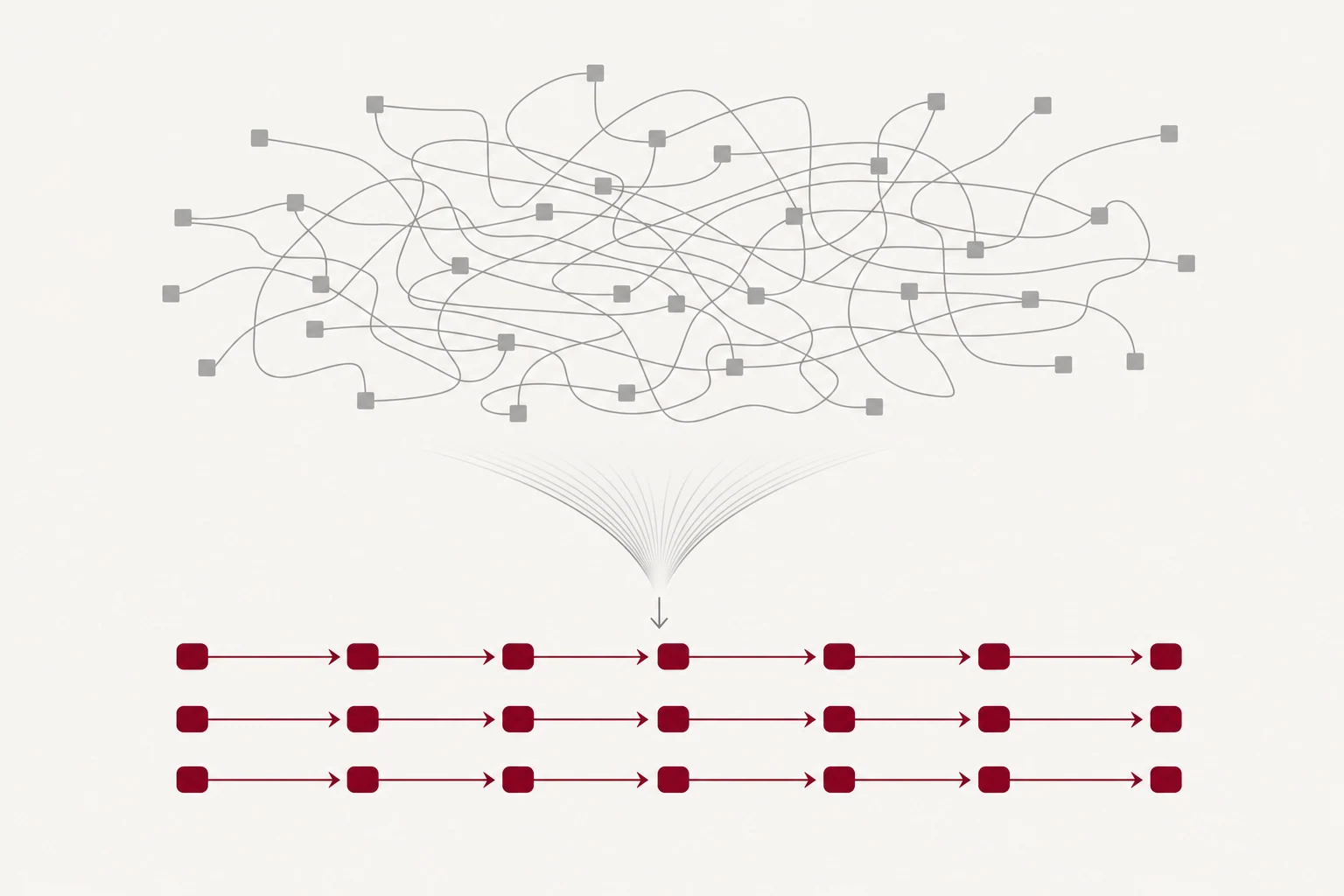
Process analysis
Not the one in the procedure manual. The real path includes the exported spreadsheet passed between two departments, the WhatsApp message that authorises the exception, and the person who knows which of two conflicting reports to trust.
That version is the one a new system has to accommodate or deliberately replace. Designing against the documented process is how organisations end up with a platform that everybody works around.
Enterprise architecture
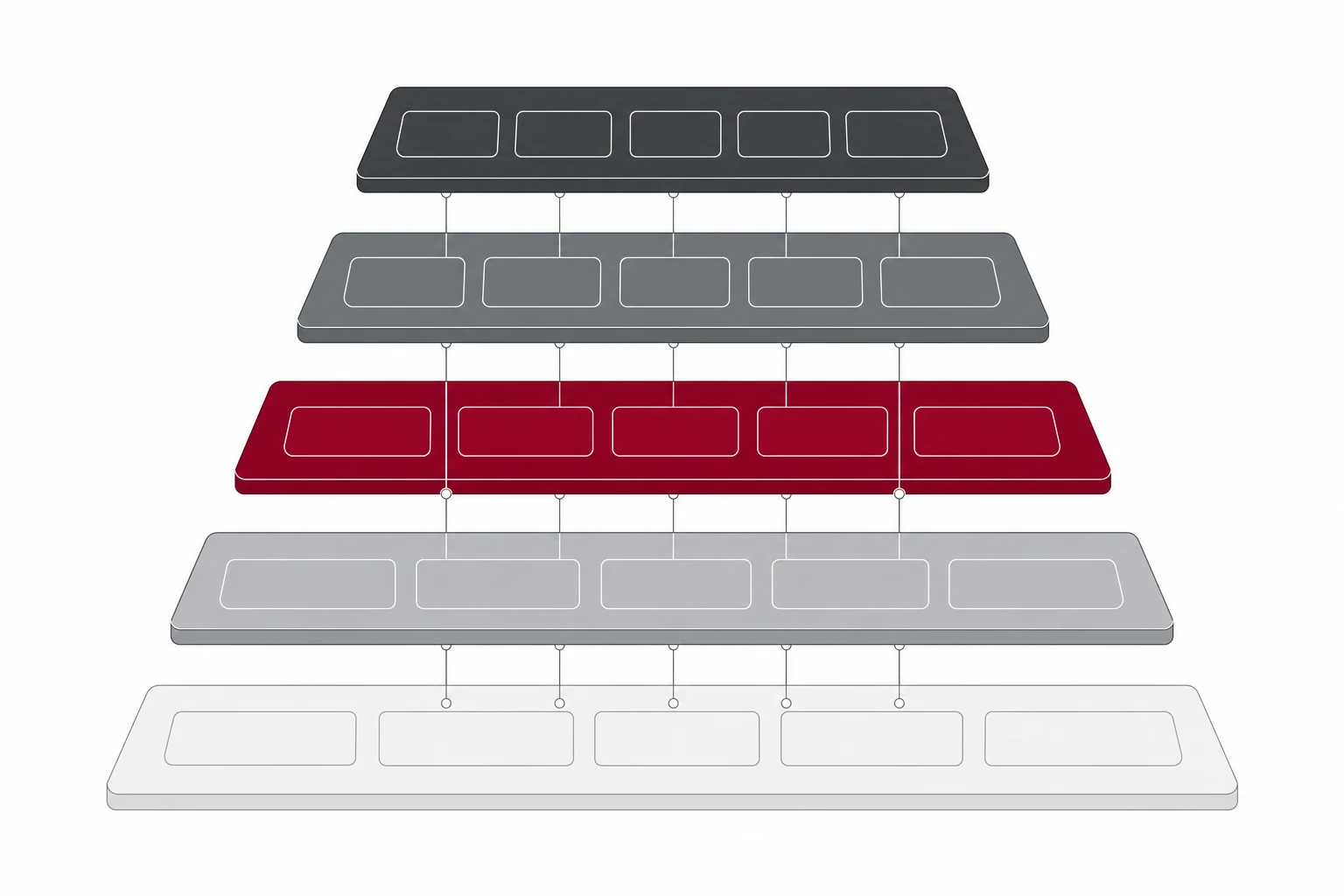
Everything else is usually present in some form. It is the absence of documented interfaces that makes every new system a bespoke bridge and every AI ambition stall at "how do we get the data out?".
Experience
Employee, customer and citizen-facing surfaces — portals, mobile, self-service and the channels each audience actually uses.
Process & orchestration
Cross-department workflow, approval authority and case handling, modelled once rather than re-implemented per application.
Applications
Core line-of-business systems, with an explicit position per application: retain, re-platform, rebuild or retire.
Integration
The layer most estates lack. Documented APIs and events instead of point-to-point bridges and nightly file drops.
Data & platform
Where records live, who owns each definition, how they are secured and classified, and what the residency constraints are.
The roadmap
Each phase ends with something running in production and a gate question. If the answer at gate two is no, the programme stops at phase two — and that is a success, not a failure.
Establish what is true today and agree what "better" means in measurable terms.
Work in this phase
Outputs
Gate question Do the gaps justify a programme, or a series of contained improvements?
Define the destination precisely enough to sequence toward it — and cost it.
Work in this phase
Outputs
Gate question Is the target state affordable, and is the first phase deliverable inside one budget cycle?
Deliver working capability in production, one bounded slice at a time.
Work in this phase
Outputs
Gate question Did the slice deliver the measured outcome? If not, why continue to the next?
Make the new way the default, and keep the estate from re-accumulating debt.
Work in this phase
Outputs
Gate question Is the improvement holding without the programme team present?
KPIs & success metrics
We deliberately publish no target values here. Baselines are measured from your own operations in Phase 01 — a benchmark borrowed from another organisation is not a target, it is a guess with a decimal point.
| Area | Measure | Why this one |
|---|---|---|
| Process | End-to-end cycle time | The single most honest measure of whether a process actually improved, rather than moved. |
| Process | Rework and rejection rate | Rising rework after a rollout usually means the design skipped a real exception. |
| Technology | Change lead time | How long a small change takes from request to production — the best proxy for estate health. |
| Technology | Unsupported components | Counts what is running past end-of-support. Auditors and insurers ask; most estates cannot answer. |
| Data | Contested measures | The number of KPIs where two reports disagree. Should trend to zero and rarely does. |
| Adoption | Active use vs licensed use | Distinguishes a deployed system from an adopted one, which is where most value is lost. |
| Financial | Run cost per capability | Makes the retire decision arguable with numbers instead of loyalty. |
| Programme | Phase gate outcomes | Records what was decided at each gate, including the phases deliberately not funded. |

Industries
A ministry's procurement calendar and an operator's shutdown window are hard constraints on phasing, not details to work out later.
FAQ
Starting the project commits you to a sequence chosen before anyone measured the current state. The strategy engagement produces the sequence, the cost per phase and the decision gates — so the first phase is funded on evidence and the fifth is not funded at all until the fourth has proven itself.
Not necessarily, and we will say so if it is. Most existing plans are strong on technology selection and thin on process ownership, data definitions and the integration layer. A short review against those three areas usually tells you whether the plan needs replacing or only completing.
No. Cloud, hybrid and on-premises are all valid endings, and for organisations with residency or sovereignty requirements hybrid or on-premises is frequently the correct answer. The hosting decision belongs in Phase 02 as an output, not in the brief as an assumption.
Phase 03 delivers a capability into production, and it is deliberately scoped to a bounded slice for that reason. If the first working outcome is further away than a couple of quarters, the slice was drawn too large and we would rather redraw it than defend the plan.
Leadership for outcome alignment and the phase gates, process owners for the as-is capture, and whoever actually keeps the current systems running — that last group holds the undocumented knowledge that determines whether a plan is realistic.
That happens, and it is a legitimate finding. Sometimes the constraint is process ownership or decision rights, and installing a platform on top of it will produce an expensive version of the same problem. We will put that in writing rather than sell around it.
Get started
Six weeks, a measured current state, a prioritised gap list and agreed KPI definitions. Commit to the rest afterwards, on evidence — or not at all.
Chat with us on WhatsApp
Pick the team you need — we'll open the chat.
Ask Teky Bot
AI-assisted · replies may contain mistakes
Please don't share passwords or personal data. AI processes your messages. See our Privacy Policy.
We set no cookies of our own and run no trackers — just two on-device preferences (theme, this notice). The Google Map on our Contact page can set Google's. Details in our Cookie Policy and Privacy Policy.