
Engineering · Application Modernization
Progress without unnecessary disruption.
The system everyone complains about is usually the one the business cannot stop using. We modernise it in controlled stages — assessing what is actually worth keeping, carving out the parts that block change, and exposing the data other systems need, while the old system keeps running until the new one has earned the switch.
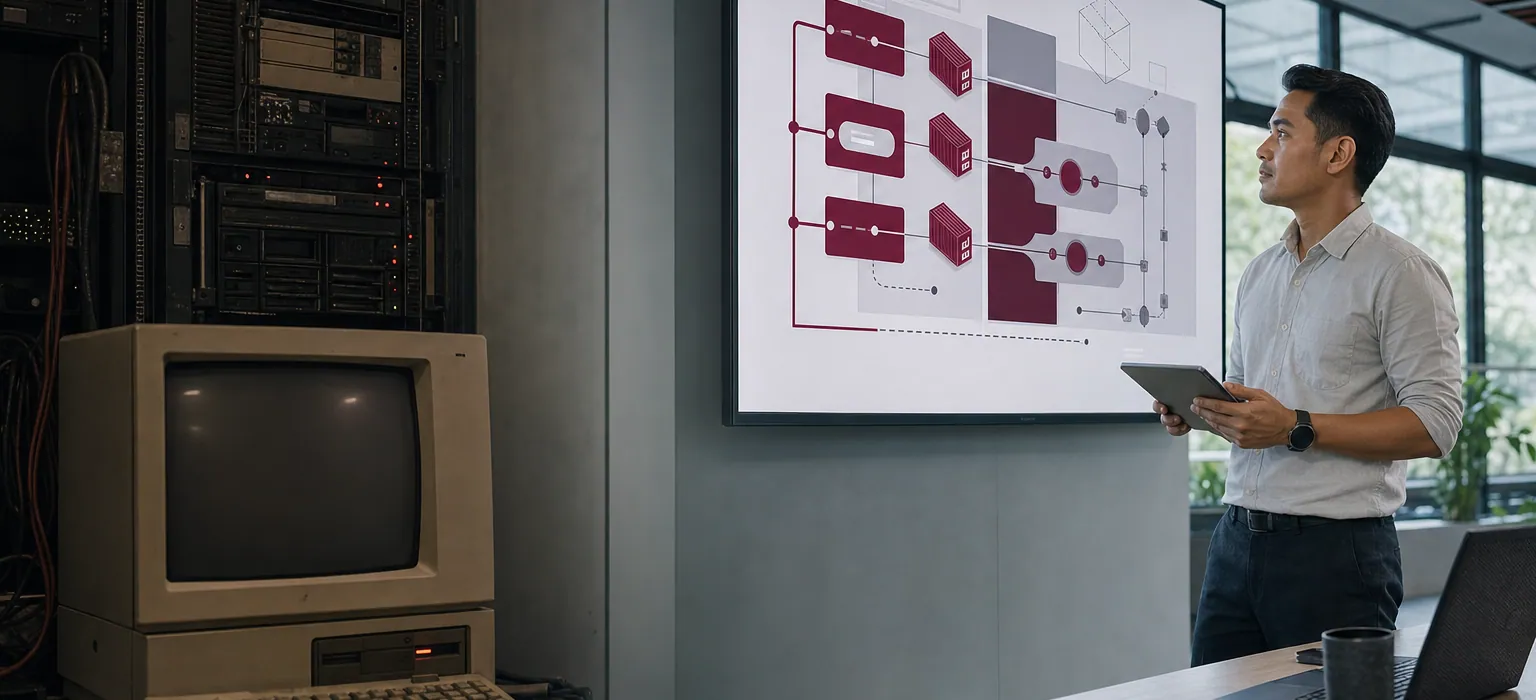
Assess · Carve out · Cut over
// What we deliver
A staged path off the system you cannot switch off.
Big-bang rewrites fail for boring reasons: undocumented behaviour, data nobody owns, and a cutover weekend that was never realistic. Everything below is designed to avoid that specific ending.
Application Portfolio Assessment
Every application scored on business criticality, technical health, integration surface and cost to run — so the modernisation order is argued from evidence, not from who complains loudest.
- Criticality & usage mapping
- Technical-debt scoring
- Integration & data dependencies
- Retain / re-platform / retire call
Re-Platforming & Refactoring
Move workloads onto a supported runtime and untangle the modules that block every change — incrementally, behind the same interfaces users already know.
- Supported runtime & framework uplift
- Module-by-module refactoring
- Strangler-pattern carve-outs
- Behaviour parity testing
API & Integration Enablement
Put a documented interface in front of the legacy system so new applications, portals and AI features can read and write without another point-to-point hack.
- Domain-shaped API surface
- Authentication & rate limits
- Event and webhook publishing
- Contract documentation
Data Migration & Validation
Extract, clean, map and reconcile the data — with a validation run you can sign off against the old system before anyone is asked to trust the new one.
- Field-level mapping
- Cleansing & de-duplication
- Reconciliation reports
- Dry-run rehearsals
Cutover & Continuity Planning
A cutover plan with parallel-run windows, rollback triggers and named owners — because the risk in modernisation is almost never the code, it is the switch.
- Parallel-run strategy
- Rollback criteria & triggers
- Go/no-go decision gates
- User comms & training sequence
Documentation & Handover
The undocumented behaviour that made the old system unmaintainable gets written down this time — architecture, decisions, runbooks and the reasoning behind them.
- Architecture & decision records
- Operational runbooks
- Rediscovered business rules
- Knowledge transfer to your team
// How we work
Assess, carve out, cut over, repeat.
Each stage ends with something running in production and a decision gate. If the business case stops making sense at stage two, you stop at stage two.
- Step 01
Assess
Inventory the portfolio, read the code and the data, interview the people who keep it alive, and score each application on criticality and technical health.
- Step 02
Sequence
Agree what is retained, re-platformed, rebuilt or retired — and in what order, with the dependencies and the business case for each stage written down.
- Step 03
Carve out
Deliver the first slice: a bounded capability moved onto the new platform behind an API, running in parallel with the legacy path until it matches.
- Step 04
Cut over
Migrate and reconcile data, run both systems side by side, then switch on agreed criteria — with a rollback that has actually been rehearsed.
// Where this helps
Signs it is time to modernise.
If two or more of these are true, the cost of waiting is already higher than the cost of a staged programme.
// FAQ
What buyers ask before committing.
Do we have to rewrite everything?
Almost never. The assessment usually finds that a minority of the portfolio is genuinely blocking the business, and the rest can be retained as-is, re-platformed cheaply, or retired once a duplicate is decommissioned. Rewriting is the last option we recommend, not the first.
Can the business keep operating during the programme?
Yes — that constraint shapes the whole approach. Capabilities are carved out behind an API and run in parallel with the legacy path until behaviour matches, so users move over in agreed groups rather than everyone at once on a Sunday night.
What happens if nobody knows how the old system works?
That is the normal starting position. We recover behaviour from the code, the database and the people who use it daily, and write down the business rules as we find them. That recovered documentation is a deliverable in its own right, independent of what gets rebuilt.
Do we have to move to the cloud?
No. Cloud, hybrid and on-premises are all valid endings, and for organisations with data-residency or sovereignty requirements on-premises or hybrid is often the correct answer. The deployment target is a decision in the assessment, not an assumption going in.
How is this priced when the scope is unclear at the start?
The assessment is scoped and priced on its own, and it produces the sequenced plan with an estimate per stage. You then commit stage by stage, with a decision gate at the end of each — so you are never asked to fund a multi-year programme on a single early guess.
Can you work alongside our existing vendor or in-house team?
Yes, and often that is the cheapest route. We can take the assessment and the architecture while your team executes, or carve out the difficult modules while they continue running the current system. Handover and documentation are built into the engagement either way.
// Get started
Start with an assessment, not a rewrite.
A short conversation about which system is hurting most is usually enough to tell whether you need a full portfolio assessment or just one targeted carve-out.