
Engineering · AI Agents Development
An agent is only valuable if you can trust what it does.
We design agents that find information, prepare work and carry out approved tasks — never beyond the permissions of the person they are acting for. Consequential steps pause for a human decision, and every retrieval and tool call leaves an audit trail you can review afterwards.
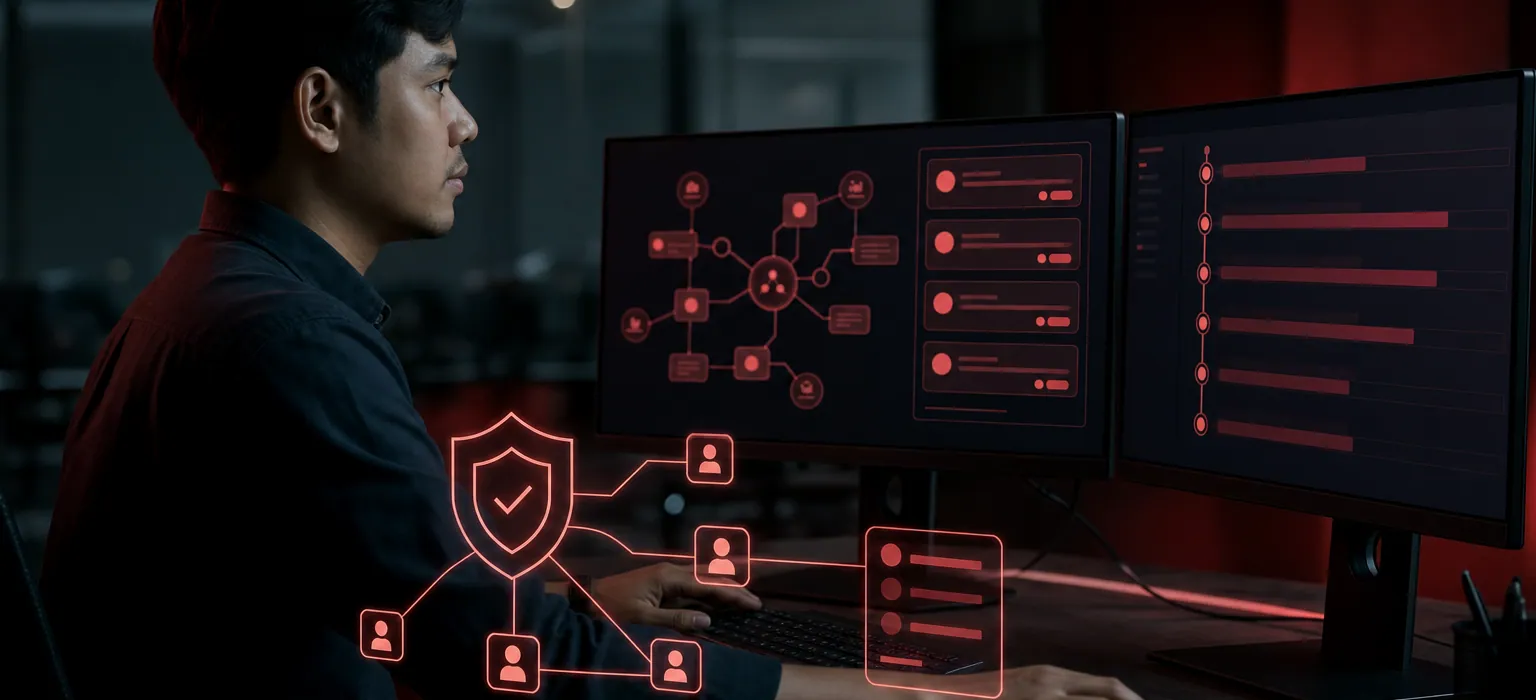
Grounded · Permission-bound · Auditable
// What we build
Agent engineering, not prompt tinkering.
An agent that survives contact with real operations needs grounding, tool access, guardrails and evaluation — built in from the first increment rather than bolted on after the demo.
Model-Agnostic Architecture
Build on leading commercial LLMs or private, self-hosted open-weight models — capability, cost and data residency stay your decision, not ours.
- Commercial or self-hosted models
- Swappable model layer
- Cost vs capability sizing
- Data-residency constraints honoured
RAG — Retrieval-Augmented Generation
Answers are grounded in your approved documents and records: your material is chunked, embedded and indexed for vector search in PostgreSQL with pgvector — so the agent reflects your organisation, not the open internet.
- Approved source inventory
- Chunking & embedding into pgvector
- Permission-filtered retrieval
- Citations back to the source
Multi-Agent Orchestration
Specialised agents with explicit hand-offs and task decomposition for multi-step work — each kept inside its own scope rather than one agent trying to do everything.
- Task decomposition
- Explicit hand-off contracts
- Per-agent scope limits
- Deterministic fallbacks
Tool Calling & API Access
Agents reach approved systems through structured tool calling and open interfaces such as the Model Context Protocol (MCP) — scoped per tool, never a blanket credential.
- Typed tool schemas
- MCP & standard REST APIs
- Per-tool permission scoping
- Argument validation before execution
Memory & State Persistence
Context carries across a task or conversation so work continues coherently — with retention windows scoped to your policy rather than kept indefinitely by default.
- Task & conversation state
- Policy-scoped retention
- Tenant-isolated context
- Explicit forget / reset paths
Observability & Evaluation
Every step traced, behaviour evaluated against defined criteria, and guardrails applied before and after each action — so "is it working?" has an evidenced answer.
- Step-level tracing
- Evaluation sets & regression runs
- Pre- and post-action guardrails
- Live monitoring & alerting
// How we build
From a use case to a supervised agent in production.
We do not start by choosing a model. We start by writing down what the agent may do, what it must never decide alone, and how you will know it behaved.
- Step 01
Discover
Define the job to be done, who it serves, which data and systems it touches, and which decisions must stay in human hands.
- Step 02
Design & ground
Shape scope, permissions, tools, approval points and acceptance criteria — then connect approved knowledge through retrieval so responses reflect your organisation.
- Step 03
Build & evaluate
Engineer in testable increments with tool access and guardrails in place early, then test behaviour against defined criteria, edge cases and risk before production.
- Step 04
Operate & improve
Launch with monitoring and tracing on, support the agent through its lifecycle, and tune scope and grounding as real usage teaches you what it needs.
// Where this helps
Agents that live inside your operating core.
The useful agents are not general assistants — they are narrow, permission-bound helpers attached to work your team already does every week.
// FAQ
Questions leaders ask about agents.
What exactly is an "AI agent" here?
Software that can retrieve information, prepare work and carry out approved tasks within defined permissions — not an autonomous system acting without oversight. Every consequential action is designed to pause for human approval.
Which LLMs do you use, and can it run on our own infrastructure?
We are model-agnostic: leading commercial models or private, self-hosted open-weight models, chosen for capability, cost and data residency. Cloud, hybrid and self-hosted deployment are all supported, and the model layer is swappable later without rebuilding the agent.
How do you stop an agent doing something it shouldn't?
Agents inherit role-based access control and least privilege, with tool access scoped per action rather than a blanket credential. Consequential steps require human approval, and guardrails are applied both before an action is attempted and after it returns.
How is this different from a chatbot?
A chatbot answers questions. An agent can retrieve, reason over your own data through retrieval-augmented generation, call approved tools and complete multi-step work — always within permissions and with a full audit trail behind it.
Can agents work with our existing systems?
Yes. Integration goes through structured tool calling and open interfaces such as the Model Context Protocol (MCP) and standard APIs, designed around your approved systems, security requirements and data ownership. Existing line-of-business systems usually stay exactly where they are.
How do we know an agent is behaving correctly?
Behaviour is traced step by step, evaluated against criteria agreed with you before launch, and monitored afterwards. Agent activity stays auditable throughout, so a reviewer can reconstruct what was retrieved, what was called and why an answer looked the way it did.
// Get started
Start with one agent that earns its place.
Pick a single narrow job that eats your team's week. We will scope it, define the guardrails and tell you honestly whether an agent is the right answer for it.